

Voters in Every Corner of America See this Election as a Referendum on Health Care Costs
By Erin Hemlin,
10.27.2026
As the 2026 midterms approach, voters are now casting their ballot or preparing to head to the polls on Election Day. Their message has been consistent all year: Americans desperately want their leaders to bring down the high cost of health care.
This summer, Families USA conducted a nationwide survey of 1,041 registered voters to understand how Americans are experiencing health care: what they pay, who they believe is driving costs, and how they view what policymakers are, and are not, doing about it. The findings are clear: health care costs are the defining pocketbook issue of this election, and that concern cuts across party, age, and geography.
Health Care is the Top Issue and it’s Not Close
Poll after poll has found that voters care about health care costs. Our data shows how deep that concern runs.
- 47% of voters name health care costs as a top priority for Congress and the President. That’s 13 points ahead of housing (34%) and 14 ahead of immigration (33%). Taxes (20%), the deficit (15%) and crime (14%) trail far behind.
- It’s the top issue for women (52%) and independents (37%), ahead of housing (33%) and immigration (26%) among independents.
Republican voters rank immigration first (58%) and health care costs third (26%), but they still say they want action. 81% of Republicans and 79% of Trump voters say it’s very or fairly important for the President and Congress to lower health care costs.
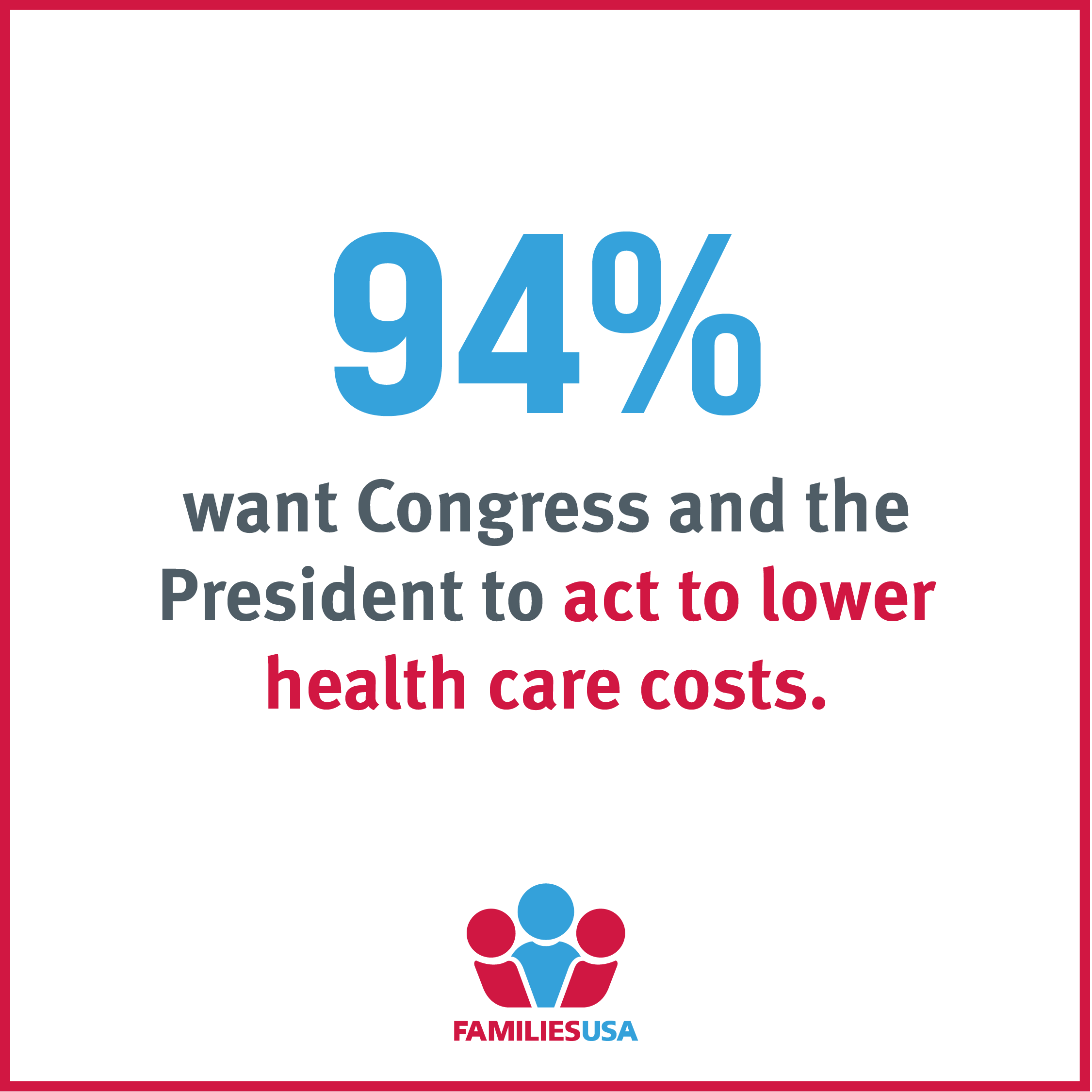
Across the full sample, 94% of voters want to see action to lower health care costs — with 74% of calling it very important. That is not a left leaning or right leaning priority, it is an American priority, and evidence that American families are deeply aware of the growing health care affordability crisis.
The Affordability Crisis Has Reached the Middle Class
Perhaps these findings are not surprising given what voters are paying for care. Nearly half (48%) of respondents say it is difficult to afford health care, including (18%) who say it is very difficult.
That strain is not isolated to low-income families or retirees on fixed incomes. Among working-age voters (18-64), 53% struggle to afford care, compared with 34% of voters 65 and older, most of whom are covered by Medicare.
What is most striking is that half (49%) of voters who describe their finances as “doing okay” still find health care hard to afford. The burden is heaviest for women ages 45 to 64 (58%) and rural voters (52%) and it reaches across the political spectrum, including 46% of Trump voters.
Premiums Increased this Year – and Voters Noticed
Voters know that marketplace premiums rose in the past year, and many know they rose by a lot. Voters are sharing these observations after Republicans in Congress let the Affordable Care Act enhanced premium tax credits expire, leading to the doubling of premiums for many ACA enrollees.
- 62% believe marketplace premiums rose over the past year, and half (50%) say they rose a lot. That includes 57% of Republicans.
Voters also aren’t buying the federal government’s explanation for the steep drop in ACA enrollment.
- Respondents were told that ACA enrollment fell by nearly 4 million people in the past year, then shown two competing explanations. The first, from the federal government, said the drop was good news because it came from removing fraudulent and “phantom” enrollments. The second said it was bad news because premiums have risen and millions of people can no longer afford coverage. By roughly 2 to 1, voters sided with the affordability explanation (51% bad news vs. 26% good news).
Voters See Corporatization, Big Systems, and Hospital Prices as the Problem
Voters draw a sharp line between the people who provide care and the corporations that profit from it.
- Doctors (net +57) and community health centers (net +46) are the most favorably viewed groups in health care. Hospitals are viewed favorably too (net +38).
- Favorability collapses as institutions get bigger and more corporate. Large hospital systems fall to net -3, and corporate health systems sink to net -38, a 76-point swing from “hospitals.”
- Pharmaceutical companies (net -54) and health insurers (net -44) are deeply unpopular, and that holds among Republicans: pharma is net -53, insurers net -36 and corporate health systems net -30.
Voters also see hospital prices themselves as a problem. 81% say the prices hospitals charge are unreasonable, including 58% who say very unreasonable, a view shared by 80% of Republicans.
They are skeptical that hospital mergers help patients. 58% expect that if a local independent hospital joined a large system, prices would rise and care would not improve. That view is nearly identical among Republicans (58%) and Democrats (60%). Only 16% expect care to get better.
And they want Congress to act. 70% find it convincing that Congress must stop the corporate consolidation driving up health care costs, including 63% of Republicans and 62% of rural voters.
Voters Reject Cutting Care to Cut Costs
Voters want lower costs, but not at the expense of coverage and the care it pays for. That is clearest on Medicaid.
- Most voters do not yet know Medicaid cuts are coming. Only 38% correctly say federal Medicaid funding is set to decrease.
- Once informed, voters oppose the cuts 60% to 30%. More than half (51%) strongly oppose them.
- Opposition extends well beyond the Democratic base. Independents oppose the cuts 52% to 27%, and rural voters 50% to 38%. Among women ages 18 to 44, 75% are opposed.
Voters also reject the argument that cutting coverage is the way to fight fraud. Only 12% say individuals lying to get benefits is the bigger fraud problem, including just 19% of Republicans. Three in four (76%) say health care companies overbilling the government is at least as big a problem, a view shared by 77% of Republicans.
The message that resonates is balanced: no amount of fraud is acceptable, but oversight should not come at the cost of coverage for people with disabilities, older Americans and low-income working people. 73% of voters find that argument convincing, including 65% of Republicans.
The Message from Voters
Across party lines, voters are telling their leaders the same thing: health care costs are too high and squeezing families who otherwise feel financially stable. Voters see corporate consolidation, insurers and drug companies driving those costs, and they reject cutting coverage as the answer.
Whoever wins in November, the mandate is clear: lower health care costs, hold accountable the corporations driving them up, and protect the coverage families depend on.
Methodology: Families USA surveyed 1,041 registered voters nationwide July 7 to 11, 2026. The margin of error is plus or minus 3 percentage points. Among respondents who voted in 2024, 50% voted for Donald Trump and 48% for Kamala Harris.
related content
Voters in Every Corner of America See this Election as a Referendum on Health Care Costs
10.27.26 / Insights Blog

Cut by Cut: What the ‘Dissecting the Deepest Cuts’ Series Reveals About H.R. 1
10.22.26 / Insights Blog

Dissecting the Deepest Cuts: New Expenses for Adults on Medicaid
10.22.26 / Fact Sheet

Dissecting the Deepest Cuts: New Barriers to Medicaid Eligibility and Enrollment
10.22.26 / Fact Sheet