



If we don’t have that [Medicaid] coverage, it’s going to lead to more hospitalizations and more costs because of not having access to care. It’s frightening to me.

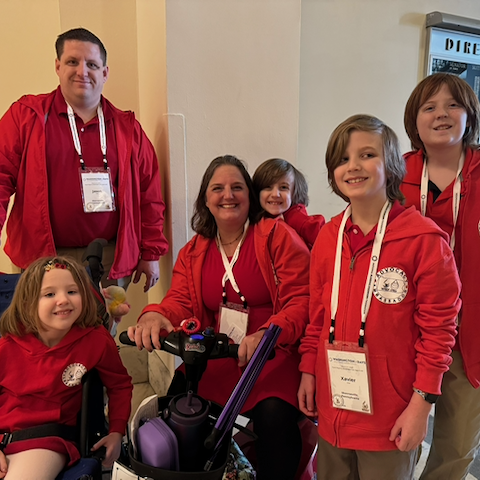
Jason Miller is a 43-year-old father of four living in Monroeville, Pennsylvania, the western part of the state. Every member of his immediate family lives with serious, complex medical conditions. His four children — ages seven, nine, eleven, and fourteen — all have glycogen storage disease, a rare metabolic disorder that causes dangerous drops in blood sugar, as well as Factor VII deficiency, a rare inherited bleeding disorder that affects their blood’s ability to clot. His wife lives with scleroderma and her own bleeding disorder. Managing it all requires the kind of vigilance most people never have to imagine.
“It’s its own full-time job to deal with managing the process of getting services,” Jason said. On top of his day job, he and his wife coordinate specialist appointments, pharmacy fills, medication dosing, nursing hours and insurance authorizations, constantly, for five people at once. When their nursing coverage falls short, as it often has, one of them steps in. “While we’re trying to work and maintain our employment, we’re also having to step into the care role with the kids and do the work that needs to be done. That doesn’t stop.”
The family’s ability to maintain this care depends heavily on Medicaid. For Jason’s children, coverage through PH95 — a Pennsylvania Medicaid provision for children with complex medical needs — has been the difference between manageable care at home and repeated hospitalizations.
The children’s conditions shape every ordinary moment. For one of Jason’s kids to play baseball, he has to have clotting factor — a medication that supplies the missing protein his blood needs to stop bleeding after an injury — available on the bench. Once, after his son was hit by a ball, Jason administered the clotting medication right there in the dugout, because waiting for emergency responders was not an option. “EMTs can’t give it. They’re not allowed because it’s a blood product. So, they have to get to the hospital first. At that point, fifteen minutes, twenty minutes, thirty minutes, an hour can pass before they get the product. The sooner you get it, the better.”
The children take this reality in stride. They have grown up accompanying their parents to advocacy visits in Washington and Harrisburg, where Jason’s son sometimes pulls out his factor kit to show lawmakers exactly what his daily life requires. “This is the medicine we use. This is how it gets mixed. This is the needle they put in my arm.” Jason has watched the effect that demonstration has on staffers and elected officials alike. “It usually results in a real moment of realization.” For his children, it is simply normal. “It’s a normal part of their lives that most people never see.”
But navigating the systems meant to support their life has been its own exhausting battle. Jason describes a process that feels “designed to be a gotcha.” His family has been caught more than once by administrative errors they did nothing to cause. Two years ago, all four of his children lost coverage for three days when their Medicaid plan failed to process their enrollment correctly under the PH95 provision and relied solely on income guidance instead. Coverage was restored, but not uniformly — the managed care organization took five more days to receive the updated information. During that window, his daughter had a pre-scheduled appointment. She received care, but the bill was never resolved. “I’m still trying to get them to finish fixing it,” Jason said, more than two years later.
His wife’s situation is similarly tangled. She should have been enrolled in MAWD — Medicaid for Workers with Disabilities — but the enrollment was not processed at the right time. She had been covered under pregnancy provisions until recently, and now, because she has taken on additional work in the interim, the family’s income may be too high to qualify. “If it had been processed when it should have been, she would have been covered, and the income guidance would have followed from there.” The family has submitted a fair hearing appeal.
Meanwhile, the enhanced tax credits that had made marketplace coverage affordable for Jason have expired. His own premium was set to jump from just under $80 a month to nearly $400. “A fourfold increase is not sustainable,” he said. “To take something that was less than $1,200 a year and turn it into roughly $4,800 a year is not a sustainable increase. Especially over the course of one year.” The plans available to him are either high-deductible or amount to catastrophic coverage — not designed for a family that requires the kind of ongoing preventative and specialized care his does. “The alternative is that people wait until things get really bad. Then they go to the hospital and end up with a multi-day hospital stay instead of handling the issue during an office visit.”
What worries Jason most about potential Medicaid cuts is not necessarily an immediate termination of coverage, but the quiet accumulation of barriers that make it harder to hold on to. More frequent recertifications, tighter deadlines, create less room for error in a system that is already prone to making errors of its own. His children’s diagnoses are genetic. They are not going away. And yet the family must prove, again and again, that the conditions still exist. “You have to recertify that your autism still exists every six months to a year,” he said, describing a dynamic that extends across every diagnosis his family carries. “But that’s the reality of it.”
He has seen firsthand that many families don’t know they can appeal a wrongful denial — or don’t know how. “Maybe 50 to 75 percent of people don’t know they can appeal or don’t know how to appeal. Those people are just out of luck.” For those families, the first decision stands. The coverage disappears. And the consequences are borne not by the system, but by the children.
With Republican health care cuts now in the implementation phase, the changes Jason feared most are starting to take shape. “The amount of medical care my kids need is dramatic,” Jason said. “If we don’t have that coverage, it’s going to lead to more hospitalizations and more costs because of not having access to care. It’s frightening to me.”
Add your voice to help us continue to push for the best health and health care for all.
SHARE YOUR STORY