


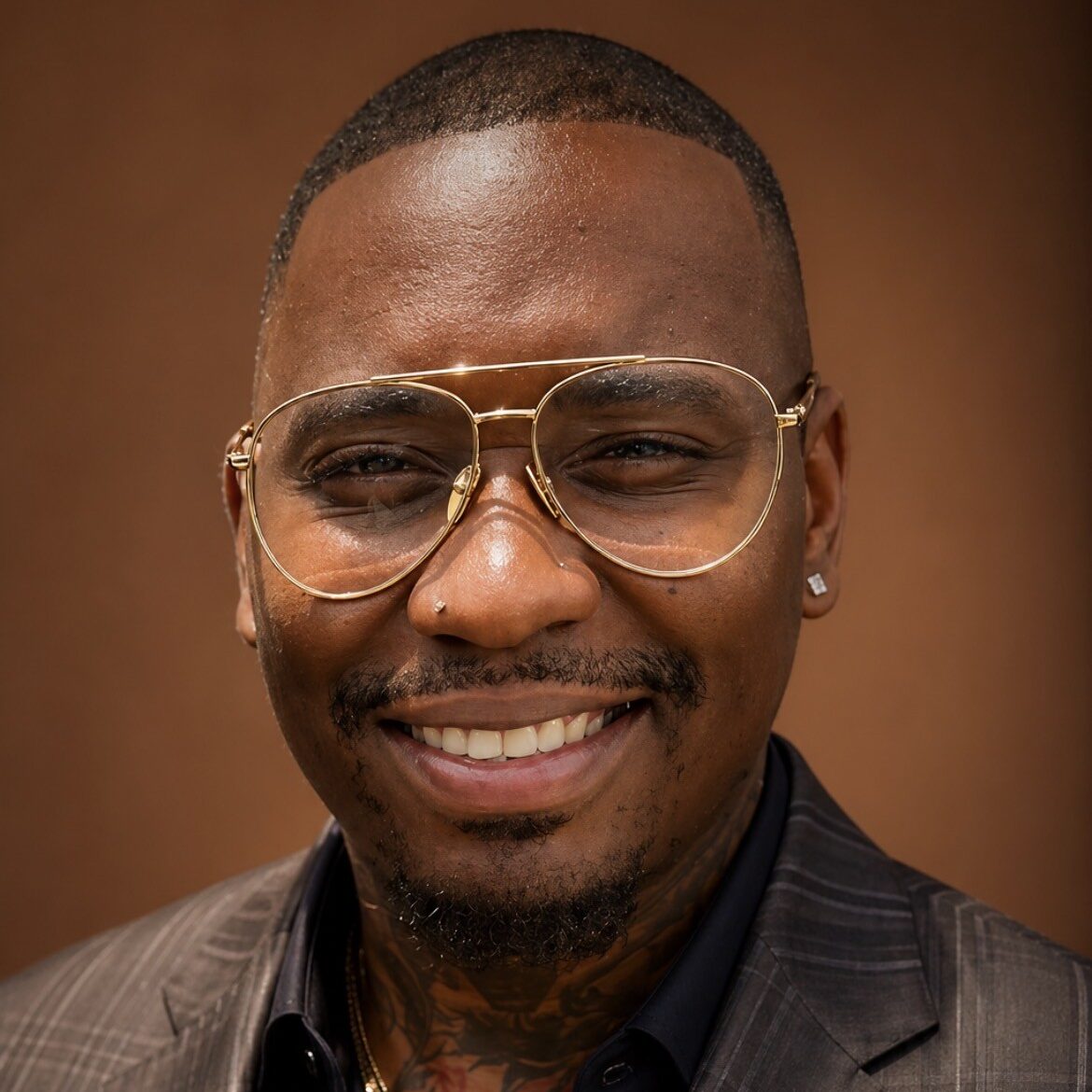
Joseph Hines is a chef from Jacksonville, Florida. He trained in the culinary program at Frank H. Peterson after attending high school, and spent time in Atlanta pursuing music before returning home to build a career in restaurants and corporate food service. Cooking, he explains, has always been tied to connection: “I love talking to people. I love engaging with people. I love inspiring people.”
Health insurance, however, has never been something Joseph could count on. Throughout his adult life, coverage has come and gone with his employment. “Jobs were kind of scarce a little bit,” he said. “So I’m working a job. Then health care kicks in.” When a job ended, so did the coverage, and COBRA was never a real option. “COBRA is very expensive, by the way,” he said. “I never did COBRA.” The result was a pattern he describes plainly: “Sometimes I have health care. Sometimes I don’t.”
Joseph traced that instability back to its start. “I originally lost my health insurance due to the loss of my job,” he said. Afterward, he tried repeatedly to find both new work and coverage he could afford, without success. “I made several attempts to find new employment and obtain affordable health insurance, but unfortunately, I was unable to find coverage that I could reasonably afford.” Even once he found employment again, the cost of covering his family remained out of reach. “When I eventually found employment, the monthly cost of insurance for both myself and my children was extremely high,” he said.
For a while, Joseph was covered through the ACA Marketplace with Florida Blue, in an enrollment story he still finds funny. A representative approached him at a downtown Jacksonville bus terminal and asked if he had insurance. “It would take me two minutes. The bus was leaving in five,” Joseph recalled. The agent got him on the phone with a representative right there, and “within like three minutes, I was already like off and running.” That coverage helped him get minor things taken care of, but like his other jobs, it didn’t last. At the time of his interview, Joseph was between coverage again. “At the moment, I just started a new job,” he said. “So I don’t at the moment.”
It was during one of these gaps that Joseph found Community Health Outreach (CHO), a free and charitable clinic in Jacksonville, initially seeking help for his teeth. He didn’t know the clinic offered medical care too, until a conversation with Dr. Rob. “I did not know that they had medical,” he said. “And I was like, medical. Whoa. Okay, cool.” He needed it. He had been in the middle of a medical process when his insurance lapsed and he could no longer continue it. Losing coverage didn’t just affect him — it reached his children as well. “When I lose insurance, my children lose insurance,” he said, explaining that even with state coverage available, providers still have to verify who holds primary insurance, and “that put my children in a rough spot.” For Joseph personally, the timing was its own kind of loss: “I was in the middle of care. And that halted everything.”
The dental crisis that first brought him to CHO had been building for a while. “I had two abscesses and some cracked teeth. I had wisdom teeth that needed to come out,” he said. “I didn’t have health insurance at all.” He turned to a Florida State College Jacksonville program where dental students, under supervision, provide care for a minimum fee. But as the students worked, it became clear the problem was bigger than a cleaning. One of the dentists stepped in: “I’m not going to put you or anyone else in jeopardy. We have to get you somewhere else to get these abscesses and everything out because we can’t do it.”
Joseph was given CHO’s number. He called, didn’t reach anyone that day, and went back to FSCJ for a follow-up appointment, where he heard the same thing again. Walking out that day, he described feeling something he hadn’t expected. “I felt ashamed, number one, because I had like four people inside of my mouth,” he said. “Especially as a man, you know, that pride kicks in.” He put it simply: “I felt like a little kid, man. I did. I felt like a little kid.” He went to a restroom and prayed. “I prayed, and I asked God, I said, Lord, if it’s meant for me to get help, I need help now, you know. And please allow them to pick up the phone if they can help me.”
That prayer led him to CHO’s Healing Hands program. A staff member named Shanoa answered the phone, found him an opening for the next day, and walked him through the paperwork on the spot. “She stayed on the phone with me, sent me the information, text me links, made everything happen for me to come in the next day,” Joseph said. When he arrived, the dentist scheduled to see him was supposed to be leaving, but stayed once she learned what he was dealing with. “She told me, she said, hey, I normally would have left, but I do not want you in pain.” That moment stuck with him. “It’s one thing to have the skill set to help people, but it’s another thing to have the heart to help people,” he said. “Because now your skill set is no longer a skill set. It is a resource, right? And she used her heart as a resource with her skill sets to help me, and she didn’t have to.”
Over the following weeks, CHO removed all four of Joseph’s wisdom teeth — the two that were broken and infected first, followed by two that were growing in sideways — then completed a deep cleaning and scaling. “I am highly grateful because those are expensive treatments,” he said. “Extractions are expensive alone. I did not have dental insurance. And this was, to me, a gift from God.”
What stayed with Joseph beyond the treatment itself was how the clinic made him feel. “It’s beyond care,” he said. “It’s family.” He had carried assumptions about free clinics before walking through CHO’s doors. “When it’s free, is something’s wrong with it. They don’t have the best people to help you,” he said, describing the stigma he’d absorbed. What he found instead were doctors with their own established practices, volunteering their limited free time. “These are doctors who are very prestigious docs. They have their own practices. They’ve been in the field for a long time,” he said. “On the time that I have time, I’m going to spend time with people that have time for me.” He also credits Dr. Rob’s visibility at the clinic with breaking down some of that skepticism: “Dr. Rob is amazing… I’m not just at the top. No, I’m not there just to be there. I’m from down here. I work my way to get here to come back down here to make sure you guys are taken care of.”
Once connected to CHO’s medical services, Joseph was able to resolve a separate, ongoing problem. He had needed a second endoscopy after one at a hospital, but scheduling kept falling through. “I needed another one done and they kept scheduling it and I had to keep rescheduling, pushing it back and pushing it back,” he said. “And when I found out about medical here, I was able to come in, see a doctor here, get a referral from a doctor here to go to Borland to be able to get the endoscopy done.”
Joseph’s health struggles didn’t end with his teeth. He described the previous year as especially difficult. “Last year was a very rough health year for me,” he said. “I have so many tests. I was in a hospital so many times. I went to the ER so many times.” He remained uninsured throughout, and the bills followed him. “I still have medical bills now. I have medical bills now from it,” he said. But in the moment, the cost wasn’t what occupied his mind. “When your body is telling you something, you’re not thinking about a bill, man. You’re thinking about, am I going to be here?” He also credits We Care, a program that partners with CHO, with helping cover costs along the way: “We care is good. I want to go on record to say that we care has helped me truly has helped me.”
By his own account, Joseph has now been without health insurance for approximately a year and a half. “During that time, I have had multiple visits to the emergency room and have also needed follow-up care with cardiologists regarding prior medical concerns,” he said. The gap in coverage, he said, has compounded an already difficult situation: “Not having consistent access to affordable health coverage has made an already challenging situation even more difficult.”
Before he ever found FSCJ or CHO, Joseph had gone to the emergency room for dental pain, worried the sharp pain radiating from his jaw might be his heart. It wasn’t — it was the infection. “The pain can radiate down to your heart or the infection can go inside,” he was told. But the ER couldn’t treat the underlying problem. “The only thing they gave me was like, oh, well, you can take Tylenol, ibuprofen and you need to see a dentist,” he said. Returning without insurance and without resolution changed how he was treated over time: “After you go so many times, it’s like, okay, why are you back? And then the treatment, the personal treatment starts to change.” For Joseph, that experience underscored something he believes should matter in every part of health care: “Character is so important in health care… you have to have a heart for people. I will stress that to the day… I don’t care how much money you make. I don’t care how much how long you’ve been in it. If you’re losing the drive and the heart for people, it’s time to go.” He often returns to a line he heard quoted: “You have a thousand problems until you have a health problem. And once you have a health problem, you only have one problem.”
Reflecting on what should change, Joseph points first to the gap between losing a job and being able to afford COBRA. He’d like to see a program built for that exact window — “if somebody loses their insurance within the same time before COBRA is introduced, they have the option of going into a program that can help them before they have to pay a thousand dollars out of pocket for something.” He also points to the cost of covering children, noting “it’s a lot of parents that don’t have insurance for children,” and argues that covering basic care matters more than people realize: “If we can find a budgeted way to make sure that everyone has health care, at least for the basics… the basics is what people neglect that gets them to the specialist.” He’s also seen firsthand how narrow Florida’s Medicaid eligibility is: “If you’re in a family of three, you’re a single parent, two kids, the most you can make is eight thousand dollars for the year” to qualify for Medicaid.
For anyone hesitant to seek help at a free clinic, Joseph has a direct message. “Silence the noise in your head first,” he said. “Try the resource. You have nothing else to lose at this point because it’s a free resource.” His advice is to set aside doubt and reach out anyway: “Take the limits off, you know, and just try it.”
Asked what inspired him to share his story, Joseph didn’t hesitate. “What inspired me is the fact that your voice counts. It matters just like your vote,” he said. “Speak about things that help you to help someone else. That’s what inspired me, because I know that I didn’t know.” For him, telling his story is a way of making sure someone else finds the help he almost didn’t.
Add your voice to help us continue to push for the best health and health care for all.
SHARE YOUR STORY