



It’s been devastating for our family.

“I have never had to tell a family this, but you guys are going to have to move out of the state if you want help.” That’s what 29-year-old Lindsey Stiefvater says the director of her daughter’s pediatric intensive care unit told her family.
Before their daughter Maggie was born, Lindsey and her husband lived in Fort Myers, Florida, where he was a professor, and she had what she called “an incredible job” with a nonprofit. “We were always financially stable,” she said.
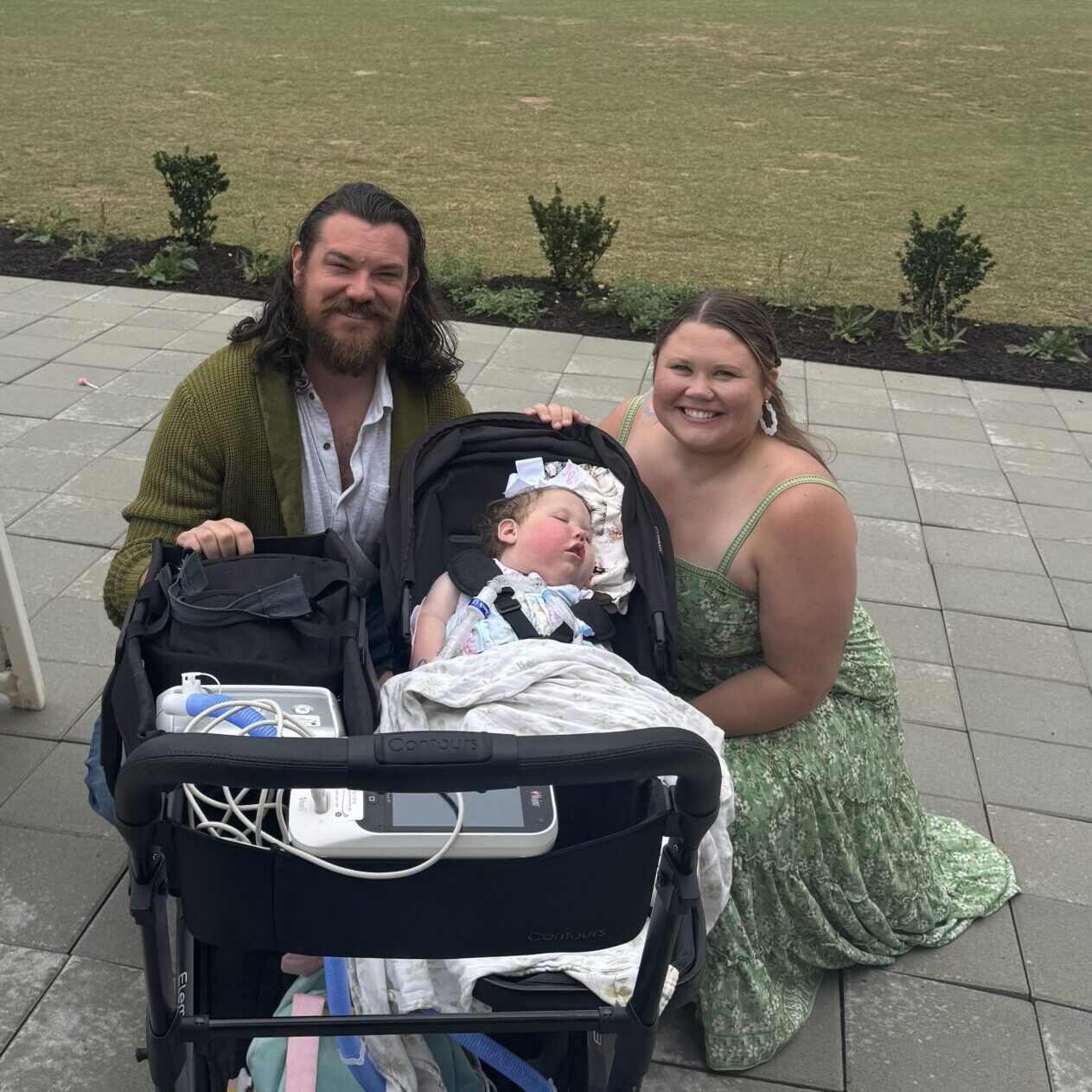
Then Maggie was born unexpectedly critically ill.
Lindsey and her husband suddenly found themselves first-time parents to a medically complex child, with no one around them who had been through it before. “And so, we didn’t really know the ins and outs of Medicaid,” she said.
Maggie arrived after 73 hours of labor. Providers check newborns with an Apgar test, a quick assessment of color, heart rate, reflexes, muscle tone and breathing. Maggie’s scores were zero, one and three. After the NICU team got her back, she was placed on Lindsey’s chest and stopped breathing again. She spent her first two months in the neonatal intensive care unit (NICU) at Golisano Children’s Hospital in Fort Myers, before being transferred.
“It was like being on a merry-go-round,” Lindsey said. “Nobody could agree what they thought was wrong.” Maggie began experiencing seizure activity on her second day of life, but the neurology team would not agree that they were seizures. She couldn’t come off high-flow oxygen, even though she appeared to be breathing comfortably between episodes. During her seizures, staff would have to “bag” her, using a hand-held bag to push air into her lungs, until she came back.
At two months old, while Maggie was hooked up to another EEG, a test that records the brain’s electrical activity, she had a fairly large seizure and coded, meaning she needed emergency resuscitation. Again, the neurologist wouldn’t agree it was a seizure. A few weeks later the neonatologist started discussing discharge with Lindsey and her husband, confused because Maggie was still having seizures they started preparing for her to come home. Later that day she ended up having another major seizure and again needed to be intubated. The neurologist was called back to Maggie’s room and after taking one look at her she dismissed the family again.
“And so that neurologist to my face said, ‘I don’t know what’s wrong with her. So just take her home and enjoy the time that you have earth side,” Lindsey said.
But Lindsey refused to accept that answer. “I told the neonatologist, you have two options here. You transfer us by the end of the day or have a plan by the end of the day, or we’re going to AMA her and I will drive her down to Miami myself,” she said, meaning she would take Maggie out of the hospital against medical advice. Within 10 or 15 minutes, the neonatologist came back to say UF Shands, a teaching hospital of the University of Florida in Gainesville, would take them. “And that was the biggest blessing in all of this,” Lindsey said.
At UF Shands, Maggie remained intubated and put on another EEG. Within 24 hours, a neurologist and epileptologist called the family at around four in the morning to confirm she was having seizures and had started her on seizure medication. A few days later she was extubated and eventually weaned off oxygen completely.
Maggie also had feeding difficulties, so she got a G-tube, a feeding tube that goes directly into the stomach, while still at the Golisano NICU. NICU staff told the family the G-tube would make Maggie eligible for Medicaid, which could provide home health nursing. “And that was not the case,” Lindsey said. “We instantly got denied from Medicaid.” But now that Maggie had a seizure diagnosis and needed oxygen as needed, the UF Shands social workers were positive they would qualify for Medicaid. Again, this was not the case.
After four weeks at UF Shands and three months in total in the NICU, the family took Maggie home to Fort Myers.
Now home, the family continued to fight for help through Medicaid and private insurance. The family’s private insurance, through her husband’s employer, wasn’t covering her care either. Even with her G-tube, her seizure diagnosis and oxygen as needed, the insurer kept saying Maggie was “custodial care,” which the plan didn’t cover. Shortly after coming home, Lindsey quit her job to stay home with Maggie, “which obviously was not the plan,” she said.
Then came another emergency room visit that would once again change the family’s plans. While in the emergency room, Lindsey said, the children’s hospital in Fort Myers told the family, “You cannot come here anymore … she’s too much, like too complex for us. We will lifeflight you to John Hopkins in St. Pete”. To give Maggie the best care, the family made what Lindsey called “a really quick move up to St. Pete” so she could continue being treated at Johns Hopkins All Children’s Hospital. “That meant my husband leaving his job, moving, finding a new job and breaking our lease,” Lindsey said. By this point, both parents had made significant career and financial sacrifices in an effort to secure the care Maggie needed and deserved.
They also had to stay close to Maggie’s new hospital. “Rent in St. Pete is very expensive, but we had to be within 15 minutes of the hospital for that comfort,” Lindsey said. The move didn’t help with the insurance issues. “Even when we got up to St. Pete, and had a new team helping us we still were facing the same thing, denied by Medicaid, but at least it got us to a better medical team.”
Meanwhile, Maggie’s health kept getting worse. In July 2025, she got COVID-19 and spent a month in the PICU, where she coded again and needed two cardioversions, procedures that use an electrical shock to reset the heart rhythm. She went home at the beginning of August but was back in the hospital at the end of September with ongoing respiratory problems. She stayed until mid-November, and during that stay, doctors placed a tracheostomy, an opening in the neck that holds a breathing tube. “When we got the trach, once again, they were like, okay, you have this trach, there’s no way that Medicaid will be able to deny you,” Lindsey said. “And yet we just kept getting denied.”
The family filed appeal after appeal, with help from social work and case management. Lindsey said the PICU director was “on the phone with our insurance company, just saying, you can’t deny this. This is crazy.” The insurer didn’t budge. “They just kept saying, she’s custodial care. She’s custodial care,” she said.
In mid-October, the PICU director told the family they would have to leave Florida to get help. “With trach kids, you know, somebody has to be awake 24-7 to watch them. And unfortunately, I knew we couldn’t stay in Florida,” Lindsey said. So, they started Googling.
They looked for a state as close to Florida as possible, allowing Lindsey to remain relatively close to family and friends while giving Maggie access to Medicaid. They chose Georgia. Georgia has a program called Katie Beckett, a pathway that lets children with significant disabilities qualify for Medicaid based on their own medical needs rather than their parents’ income.
They left the PICU on November 17, 2025 and drove to Georgia five days later. They moved into a townhouse outside Atlanta, and her husband started a new job about two weeks after that. “We thankfully have my best friend who happens to live here, but that was all,” Lindsey said. They had to find new doctors at Children’s Healthcare of Atlanta, learn the new route to the closest emergency room and start building a new community
The Katie Beckett office had told Lindsey that applications usually take about two months. She started Maggie’s application right after they arrived and had everything in by December. Then came a government shutdown and cutbacks, and Lindsey said during this there was one case manager for the whole state of Georgia handling Katie Beckett applications.
Maggie was finally approved in July 2026. Medicaid now covers her home health nurses, supplies, and office visits.
Leaving Florida also meant leaving behind the support system that had helped the family navigate Maggie’s increasingly complex medical needs. In Florida, Lindsey’s mother, a nurse for over 40 years, was close by, as were her sister-in-law, an ICU nurse, and her sister-in-law’s sister, a pediatric respiratory therapist. “I had all three of them right there,” she said. Along with many of their friends and the care team at John Hopkins All Children’s that became family.
One of the hardest decisions Lindsey said was leaving Maggie’s neurologist from UF Shands, and Lindsey said he was a huge factor in deciding whether to leave Florida at all. “He’s an angel on earth,” she said.
“It is a lot uprooting your life and leaving everything that you know.” Still, Lindsey calls Maggie’s new hospital and medical team fantastic. “We’ve also gained a lot of life back, having moved,” she said.
But while the move to Georgia ultimate gave Maggie access to the coverage and care she needed, it couldn’t undo the financial hardship the family had already endured.
By then, the damage was done.
“We are hundreds and thousands of dollars in debt,” Lindsey said. “So, it’s been devastating for our family.” She shared the family owes about $117,000 for Maggie’s care just from last July, not including everything before and after that stay. When the collection notices started coming, “I would cry,” she said. “I’ve accepted it, but it is very unfortunate because when those go to collections, it digs a continuous financial hole and is kind of a deciding factor if you’re ever going to be able to buy a house or live comfortably again.” Beyond the medical debt, the loss of one income and nearly two years of living paycheck to paycheck and relying on credit cards have taken a toll on the family. Lindsey believes much of this financial hardship could have been avoided if Maggie had received the coverage and support she needed earlier.
For Lindsey, owning a home is about more than money or square footage. It is about creating a place where Maggie’s memories remain. Doctors told the family not to expect Maggie to live a year. She turned two in July.
“We know that Maggie’s time here on earth is limited” Lindsey said.
Medical debt has made it difficult for the family to move beyond renting and into what Lindsey describes as a “forever home” for Maggie.
“This is going to sound very morbid, but I don’t want her to pass in a rental and then have to leave her memories behind,” she said.
Lindsey wants policymakers to understand what families go through when they have medically complex children. “My biggest thing would be to truly try to walk in a medical family’s shoes,” she said. She doesn’t think a child’s coverage should depend on their address. “There are people in Florida who don’t have the opportunity to move like we did and then they’re just stuck,” she said. “It should not be a choice. It should not be up to the states.” For Lindsey, the standard is simple. “You do it because it’s your child and you show up for them every single day,” she said. “And this is a government that says that they show up for their people, but I feel like that’s a pretty limited statement when you’re not showing up for those who can’t show up for themselves, right?”
Add your voice to help us continue to push for the best health and health care for all.
SHARE YOUR STORY