



When you are chronically ill, you’re chronically ill for life … You’re dependent on the health care system until you die. And you hope that that health care system will be in your corner instead of fighting against you.

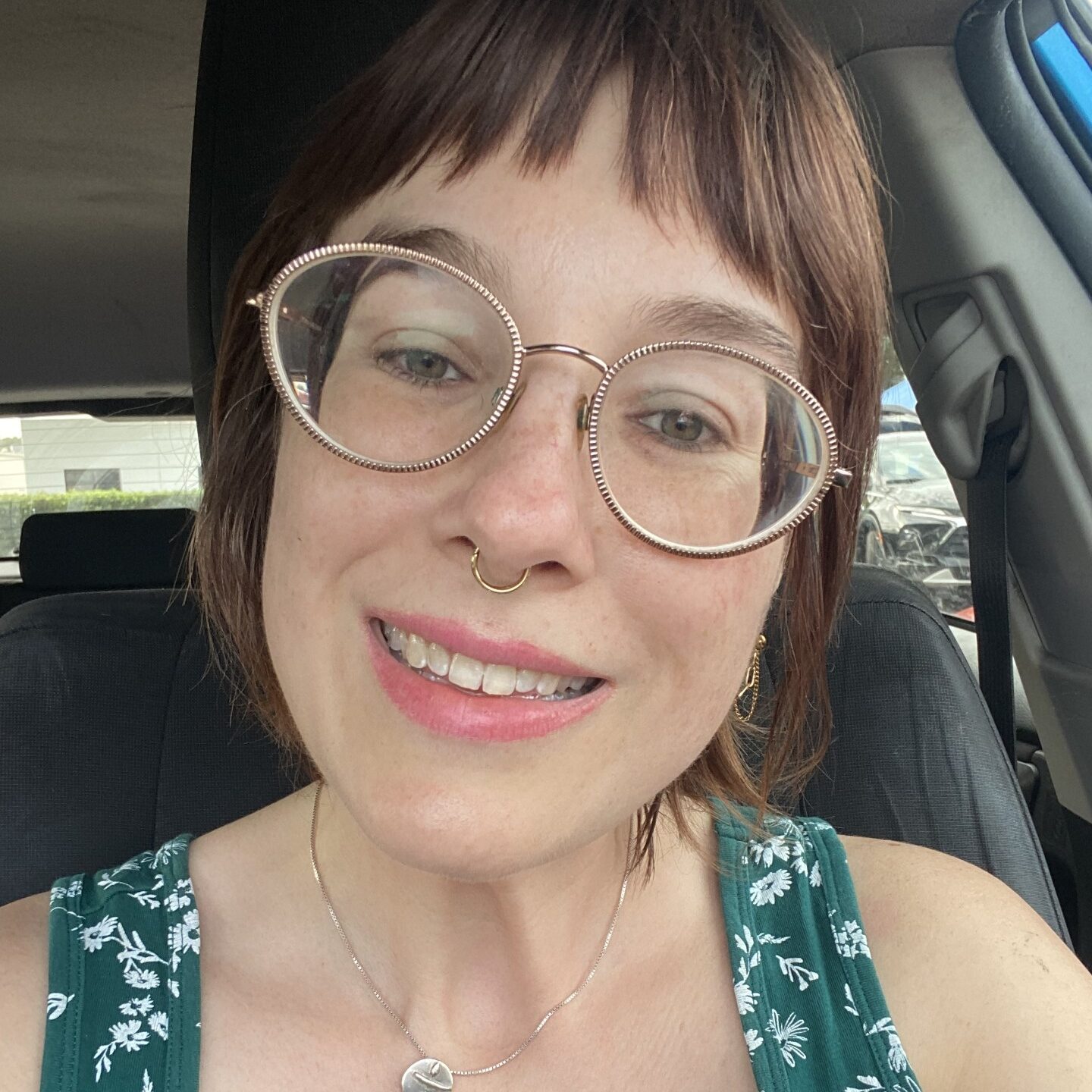
At 38 years old, Caitlin McElroy has lived in cities across the country and spent a year working in Taiwan, but she started out in Orlando, Florida, and that is where she calls home today. She works part time as an enrollment navigator at a college in Orlando. Outside of work, she spends time with her friends and her boyfriend, sings in a chorus and attends church every Sunday. “I just like being out there. I like being involved,” she said.
Her job means a lot to her. “I feel like I’m putting my soul into this job. I really love my job. I love the students I work with at my job and helping them,” she said. But her employer caps her hours at 29 a week, just under the threshold for its health benefits. “It’s really, really hard to put blood, sweat, and tears into this job, and then just be at that cap right there where you can’t have access to health care.”
For Caitlin, who has lived with Crohn’s disease since she was around 20, that access is not optional. “Once you have a chronic condition, you have it for life,” she said, “and you’re at the whims of the people who provide the insurance and decide how it’s going to be dispersed.”
When her symptoms started, she was sure it was something else. “It was just like these pains down my sides. And it was really, really bad. I was vomiting, intestinal pain,” she recalled. “It felt like something was gnawing at my insides.” Her dad knew a gastroenterologist, but it took a while to get a diagnosis. When the doctor’s nurse practitioner asked whether anyone in her family had Crohn’s disease, Caitlin resisted. “I was like, no, it’s not Crohn’s disease. It’s parasites. I know it. I don’t have a lifelong disease. Definitely not me.” After a couple of endoscopies and colonoscopies, which she called “super expensive,” she was diagnosed with Crohn’s, a chronic condition that attacks the intestines. Early on in her diagnosis, her parents were able to help with a lot of her co-pays and out-of-pocket costs. “But times have changed with the economy and everything,” she said. “And as I’m working still part-time, it’s really hard to keep up with medical costs.”
Caitlin was on her parents’ insurance until she aged out at 26 years old. “When I turned 26, that was really the moment that I was shocked that I was kind of abandoned in the American health care system with no escape to care for myself in the way that I needed to be,” she said. She was in graduate school, could not get insurance and lost access to Remicade, the biologic medication that suppressed her immune system so it would stop attacking her intestines. “And because I lost access to that, I actually became immune to it, which is a problem with biologics.” Only a few of these medications are on the market. “That was one that I lost out on.”
Since then, she has taken Humira and now Stelara, with steroids as a stopgap in between. “It’s about $25,000 a month to pay for,” she said of Stelara. “They have a payment plan where they’ll cover the initial costs and then it kicks back to your insurance so that your out-of-pocket and your co-pay is covered so that the insurance has to pay. But obviously, the insurance fights that really hard. So if I was off it, I would be in trouble for sure.”
Caitlin also lives with anxiety, depression and premenstrual dysphoric disorder (PMDD), and she needed antidepressants, anti-anxiety medication and birth control to manage her symptoms. “It was a roller coaster just getting off and on health insurance as I joined a full-time job, then got a part-time job,” she said. Her conditions made steady work hard to hold, and steady work was the way to get coverage. “I felt like having a full-time job was so impossible with the mental state I was in and physical state I was in. And I needed a full-time job in order to get access to that help.”
Then the Marketplace launched.
“That was amazing because of pre-existing conditions. A lot of times, insurance wouldn’t accept me.” A friend helped her enroll several times as she fell off coverage and got back on.
She also moved often. “I think that’s one of the reasons I moved so much, honestly, was because I was so anxious and I was so depressed and I thought I could leave my brain behind. And I never could.”
Her moves around the world showed Caitlin how different health care can be. In Taiwan, she worked at an elementary school, where she taught a cohort of three-year-olds. “I could just go down to the bottom floor of my building and walk in to my doctor’s office and I’d see a doctor within 15 minutes. I had access to medication that was dispersed at the doctor’s office. I’d walk out and it’d be less than $20, sometimes less than 10.” In Gainesville, Florida, by contrast, her employer kept her just under full-time hours, and she paid about $300 a month for a basic plan. “I don’t think I was getting coverage for Crohn’s at the time, just because I couldn’t afford a more expensive plan, unfortunately.”
In New Jersey and New York, Caitlin had Medicaid. There was sometimes a lot of waiting, but “I could do a colonoscopy and it didn’t cost me an arm and a leg,” she said. She also had a therapist she could keep seeing. Coming from Florida, that stability felt strange at first. “I almost felt like I didn’t deserve it. Which is a weird thing to say. But American society kind of makes you feel like you don’t deserve to be healthy.” Medicaid changed that. “I felt stood up for and I was my own person who could keep up with everyone else. And I wasn’t running at negative 10. I was running at zero or one with everyone else and then had my own opportunities to expand.”
Caitlin eventually moved back to Orlando. “I wanted to be closer to my family and so I was willing to move back here but it was kind of at a cost to my health.” Putting down roots “made me accept the need for health insurance in my life, like no matter the cost.” Florida never expanded Medicaid, and she relies on a Marketplace plan. That coverage pays for a psychiatrist and weekly telehealth sessions with a therapist. When the negative voice in her head starts nagging, she said, “now my therapist voice is kind of there arguing with it.” She added: “…the new access to therapy and psychiatry I have right now. I feel like I finally kind of bloomed in myself a little bit, which I’m really grateful for.” Without it, she said she would be “definitely not working,” and that if she did not have her parents to lean on, “maybe homeless.”
Caitlin knows how much her need for coverage can be used against her. “When there are tools in the health care system to manipulate people, to push them off health insurance, it’s dangerous,” she said. “I feel sometimes like I am in danger because I am going to lose access to this. I feel vulnerable.”
In 2020, in the middle of the pandemic, a fistula left Caitlin unable to keep anything down, and she needed a colon resection. “I signed that paperwork saying that I’d be on the hook for 75K, but I’d die otherwise, you know? So it wasn’t really a choice for me. You know, gun to your head, what do you do?”
For several years, Caitlin was covered under her ex-husband’s health plan. During their divorce, she said, “he definitely used it several times to hold it over my head in order to get what he wanted from the divorce.” When she asked for more mediation, “that was when he really was like, I’m going to cancel your health care if you keep pushing back. And so I kind of just gave him what he wanted at that point.” She gave up better alimony and a car. “I was so terrified of that gap between when I would get off my Stelara and when I could get back on it in time to not become immune to it.”
Today, the cost of staying covered keeps climbing. Last year, her premium went from about $32 a month to between $85 and $90. “It’s tripled, which is incredibly hard to deal with,” she said. She estimates she easily pays another $150 a month in co-pays and prescriptions. “You’re still putting so much money into that black hole to cover yourself and to take care of yourself.” Still, she knows how much she is willing to sacrifice. “I would give the lion’s share of my income in order to have insurance. That’s how important it is to me. I just, I fear pain, I fear death.” She added, “So they’ve kind of got me by the throat in that way.”
She is working toward a full-time position, sharing that, “it would be a life changer.” In the meantime, her health and her work remain tied together. “I am such a good employee because of the medications and health care regimen I’m on,” she said. Until something changes, “I just feel like there’s a sword hanging over my head a lot of the time. That stuff that my health care could be changed on the whim of a government official as opposed to having something solid.”
Her message to lawmakers is direct. “When you are chronically ill, you’re chronically ill for life. And because of that, you give something, you give up something of yourself to the health care system. And you just hope the health care system doesn’t take advantage of you,” she said. “You’re dependent on the health care system until you die. And you hope that that health care system will be in your corner instead of fighting against you.”
For Caitlin, the stakes are simple: “Affordable health care means being able to be the best version of myself I can ever be.”
Add your voice to help us continue to push for the best health and health care for all.
SHARE YOUR STORY