



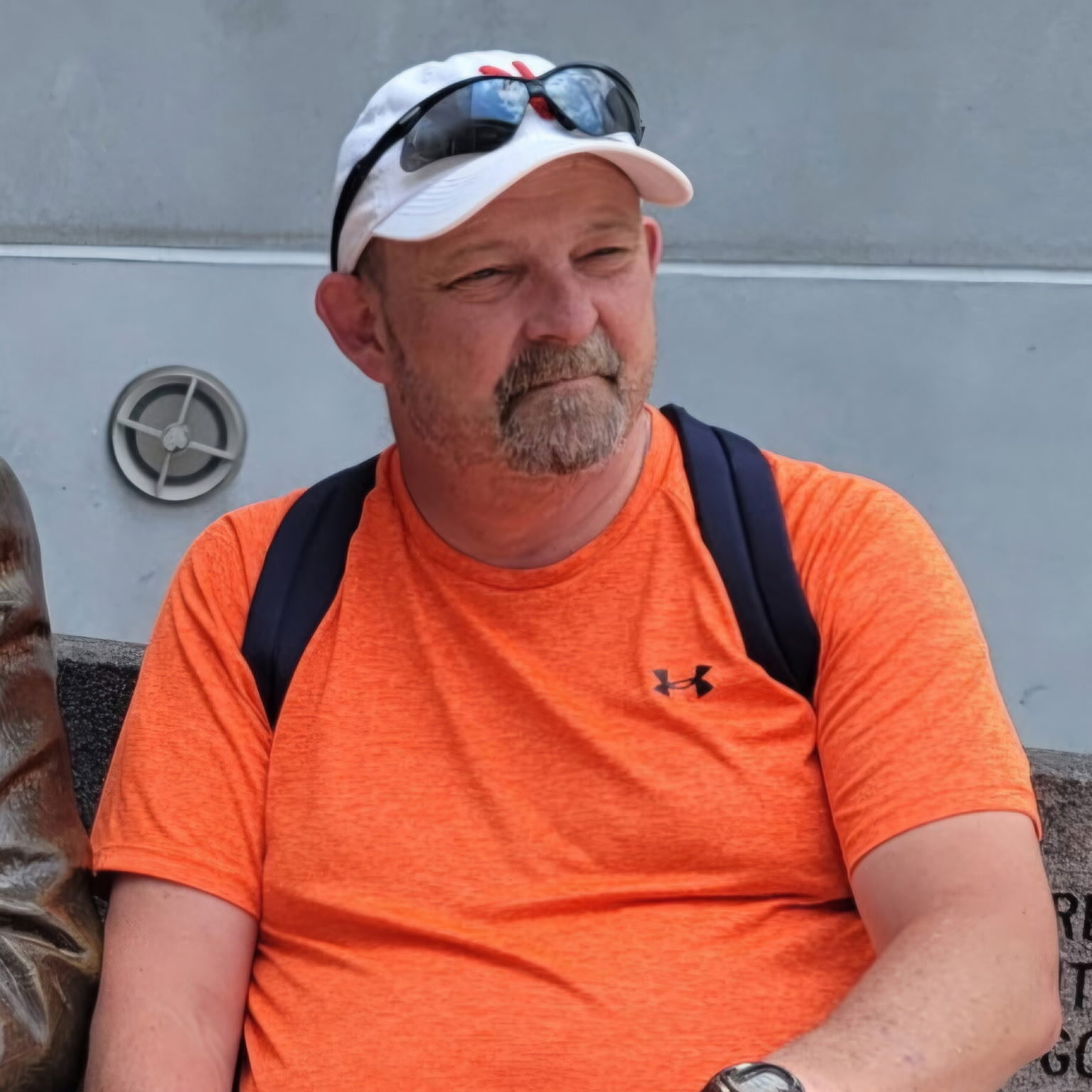

It’s so frustrating to have the cure out there, but you can’t afford it.

Jeff has spent his life in Scottsbluff, in western Nebraska. He built a career in management, running auto sales departments, before neuropathy forced him into early retirement. “Due to my neuropathy, I had to retire earlier than I wanted to. And with that, of course, I lost my insurance, and that’s why we’re here,” he said.
The neuropathy traces back to pancreatic cancer, which Jeff survived 13 years ago. He is now on Social Security Disability, backdated to October 2024. He and his wife, who runs her own insurance and financial services agency, still don’t know when his Medicare coverage will begin — it could be as early as October 2026 or as late as May 2027, depending on how the waiting period is calculated.
Last year, Jeff and his wife had a Silver plan through Blue Cross Blue Shield on the Marketplace, paying $1,400 a month with the help of premium tax credits. That changed at the end of the year. “We were notified… that we would not be receiving those credits any longer, and that our Blue Cross Blue Shield coverage would go from $1,400 to $3,800 a month, and which was undoable, because that comes to $45,000 a year, a salary for somebody,” Jeff’s wife explained.
They looked into private coverage instead, but Jeff was turned down because of his pancreatic cancer history, and his wife was declined because of a past skin cancer diagnosis. That left them with Ambetter, a Bronze marketplace plan costing $2,700 a month, with a $7,500 deductible per person and a $10,000 out-of-pocket maximum. “It’s basically just a major medical, you know, we can, I guess we’ll just carry the burden of $3,000, $5,000, $10,000, but if we ever ran into a $300,000 incident, that’s what I’m hoping [it would cover]” Jeff said.
Jeff is diabetic and relies on an insulin pump paired with a continuous glucose monitor. Ambetter will not cover the monitor. “I have a pump, which requires a constant glucose monitor, and they’ve refused it, so I’m having to go online and buy it from a place in Japan,” he said. On top of that, the pump itself is failing. It’s out of warranty, and where Jeff used to charge it once a week, he now has to charge it every 48 hours. Ambetter would only cover half the cost of a new one, which runs $13,000. “It just, it disgusts me. It shouldn’t be that way. I shouldn’t have to wait, you know, I’m willing to pay if somebody helps me out, and there’s just nothing there. There’s no olive branch. It’s a frickin’ dead tree branch is what it is,” Jeff said.
When a diabetic ulcer developed on Jeff’s foot, doctors weren’t sure at first whether it could be saved. An MRI was ordered through the hospital, at a price point of nearly $900 out of pocket up front, with the remaining cost then applied toward the $7,500 deductible. Jeff’s wife found a newly opened outpatient radiology group instead, which could do the scan for $1,000 cash — no insurance billing at all. “And their equipment is newer, and it’s a brand-new facility,” Jeff said, comparing his options. The family has been paying for costs like this through a health savings account. “So right now, I personally am wondering how much a big toe is worth, because we’re already probably in $7,000,” Jeff said. Fortunately, the injury responded well to treatment.
The complications with their insurance have also shaped Jeff’s treatment plan directly. A specialist recommended a treatment, but after learning about his insurance, decided against pursuing it — until Jeff mentioned that he’d gone on disability from work, at which point the doctor got him approved for two sessions. The treatment is supposed to happen weekly, but because his insurance declined to cover it at that pace, the doctor is stretching sessions out to every two weeks instead, an adjustment made to fit what insurance would allow rather than what the doctor believes is the most effective schedule.
Jeff’s frustration extends beyond his own situation. “It’s so frustrating to have the cure out there, but you can’t afford it. And I feel thankful every day that at least we can tread water. I wonder, these people that just go without because they can’t afford it … they either eat or they take their medicine, it’s sad. I mean, are we the United States?” he said. For Jeff, the issue is not with the treatments available to him, but with a system that puts them out of reach — and it’s that gap between the care that exists and the care he can actually afford that keeps him speaking up about what his family is living through.
Add your voice to help us continue to push for the best health and health care for all.
SHARE YOUR STORY